
tracking every change to the global Supercharger network
A data pipeline that snapshots all 10,000+ Tesla Supercharger sites worldwide and logs exactly what changed at each one between runs (openings, closures, stall counts, power upgrades, non-Tesla access), using schema-driven field-level change detection.
the problem
Tesla’s Supercharger network keeps changing: new stations open, existing ones gain stalls or power, some close, and more of them open up to non-Tesla cars. A snapshot of the network tells you what exists today. I wanted the history as well: what changed at each site since the last check, which is the part that matters if you are tracking how charging infrastructure grows.
I built a small pipeline, during the same internship at AlphaGeo as my data center atlas, that keeps its own copy of every Supercharger site and records each change field by field, building up the history a single snapshot can’t show.
how it works
The pipeline pulls the full global dataset from the supercharge.info API, compares it with a local SQLite copy, and writes every changed field to an append-only log. The database currently holds 10,443 sites.
schema-driven change detection
This is the core of the system. Rather than hardcoding which fields to compare, I use SQLAlchemy’s inspect() to loop over every column in the ORM model and compare each normalized old value with the new one. Adding a new tracked field means adding one column to the model; the diff logic picks it up automatically with no other code changes.
value normalization
The normalize() function stops values that haven’t really changed from being logged as changes:
- Floats: GPS coordinates rounded to 6 decimal places (~11 cm precision) to avoid floating-point drift across API calls
- Datetimes: handles both Python
datetimeobjects and ISO 8601 strings, converting both to the same.isoformat()string - Nulls: treats
Noneand empty strings as the same missing value - Booleans and strings: compared by type, with whitespace trimmed
data model
23 columns per site: full address, GPS coordinates, stall count, power capacity (kW), solar canopy presence, battery storage, non-Tesla EV access, PlugShare and OSM cross-reference IDs, elevation, operational status, and date fields.
architecture
- Idempotent upserts: each run inserts new sites or updates existing ones by primary key lookup, safe to run on any schedule
- Database-agnostic ORM: SQLAlchemy with SQLite for local use, swappable to PostgreSQL via connection string
- Append-only changelog: timestamped, field-level change records in
tesla_update.logrecord how the network has changed over time
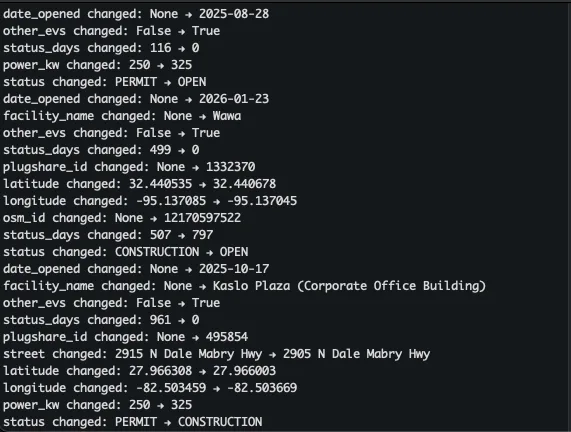
Here’s a sample of the changelog showing real changes: stations opening, power upgrades, GPS coordinate corrections, and new cross-reference IDs being added. Across its runs so far the log has recorded 1,215 new sites and 5,122 field-level updates, including 1,205 new sites between a run in May 2025 and the next in March 2026.
limitations
- It runs on a cron schedule, so a site that changes twice between runs shows up as one net change, and the schedule sets the resolution of the history.
status_days, a counter of how long a site has been in its current status, goes up by itself even when nothing at the site changes, so it appears in about three quarters of all logged updates. It should be excluded from diffing so the real changes stand out.- The changelog is a text file. Querying the history (“every site that gained power in 2025”) would need it loaded into a table first.
what stuck with me
Let the schema drive the diff. Using SQLAlchemy’s column inspection as the single source of truth for both storage and change detection meant the schema and the diff logic could never drift apart.
Normalization is the hard part. The change detection logic itself is short. The engineering work is making sure that “42.123456” and “42.1234561” don’t trigger a spurious update, and that a missing value reads the same whether the API sends null or an empty string.