
mapping your skills to realistic career moves
A Singapore career guide that maps a person's skills to realistic next roles, skill gaps, live courses and matching jobs, using official SkillsFuture data with OpenAI as the interpreter and a 3D role sphere. Won 1st at the OpenAI x AI Singapore x PyCon Singapore 2026 hackathon.
the problem
Career advice usually fails in one of two ways. It is too generic, like “learn AI,” or too overwhelming, like a wall of 500 skills with no priority. Neither tells you what to do on Monday. Someone thinking about a next move really wants three answers:
- Where do I stand right now?
- Where can I realistically go next?
- What should I do today?
careersphere answers those for anyone in Singapore, from students to senior professionals changing fields. You paste a resume or describe your background in your own words, and add constraints like salary or timeline if you have them. It then shows which official roles you are ready for, which are within reach, the skills that would unlock them, live courses to build those skills, and real job postings that match.
I built it with my friend Kieran Ho for the PyCon Singapore 2026 hackathon, run with OpenAI and AI Singapore, and we won 1st place. I did most of the work on the scoring engine, the OpenAI tool loop, the front end and the hosting; Kieran built the daily job ingest. The rule we built everything around: the data decides and the AI interprets.

what we built
Under the hood, careersphere parses your profile, maps your skills onto official SkillsFuture skills, and scores you against every official role’s requirements. The first screen asks for your background and where you want to go:
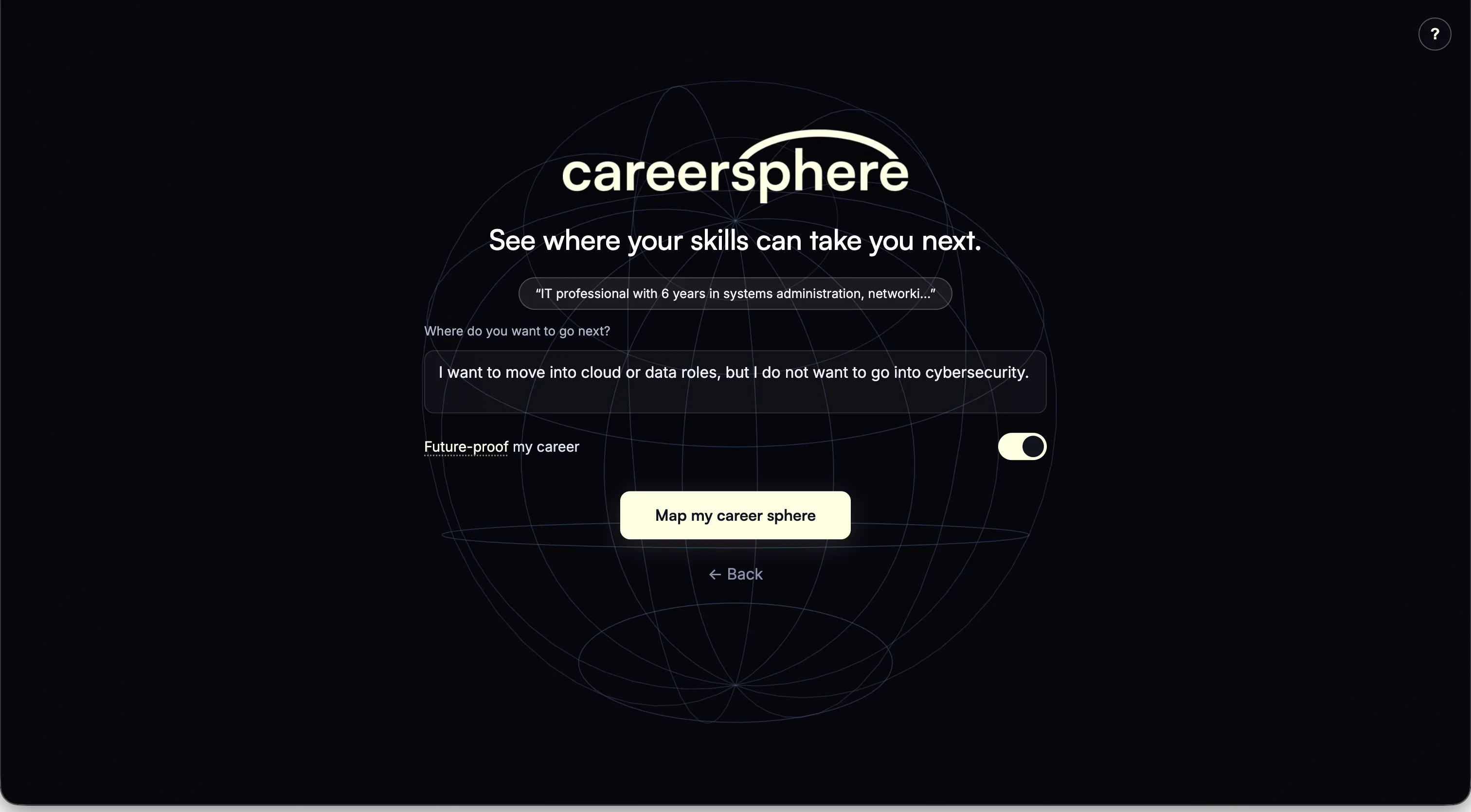
The flow is deliberately linear: onboarding, live analysis, sphere, where you stand, where you could go, then how to get there. Career tools get messy when they put every direction on one dashboard and leave the user to piece it together. careersphere moves one step at a time instead: understand the person, show the landscape, explain the realistic options, recommend an action.
the career sphere
The visual center of the product is a 3D career sphere. You sit at the center. Every official Singapore role becomes a node. Roles closer to you are more relevant to your background; roles farther away need a bigger jump. A node’s color runs from green to yellow to red depending on how ready you are for that role.
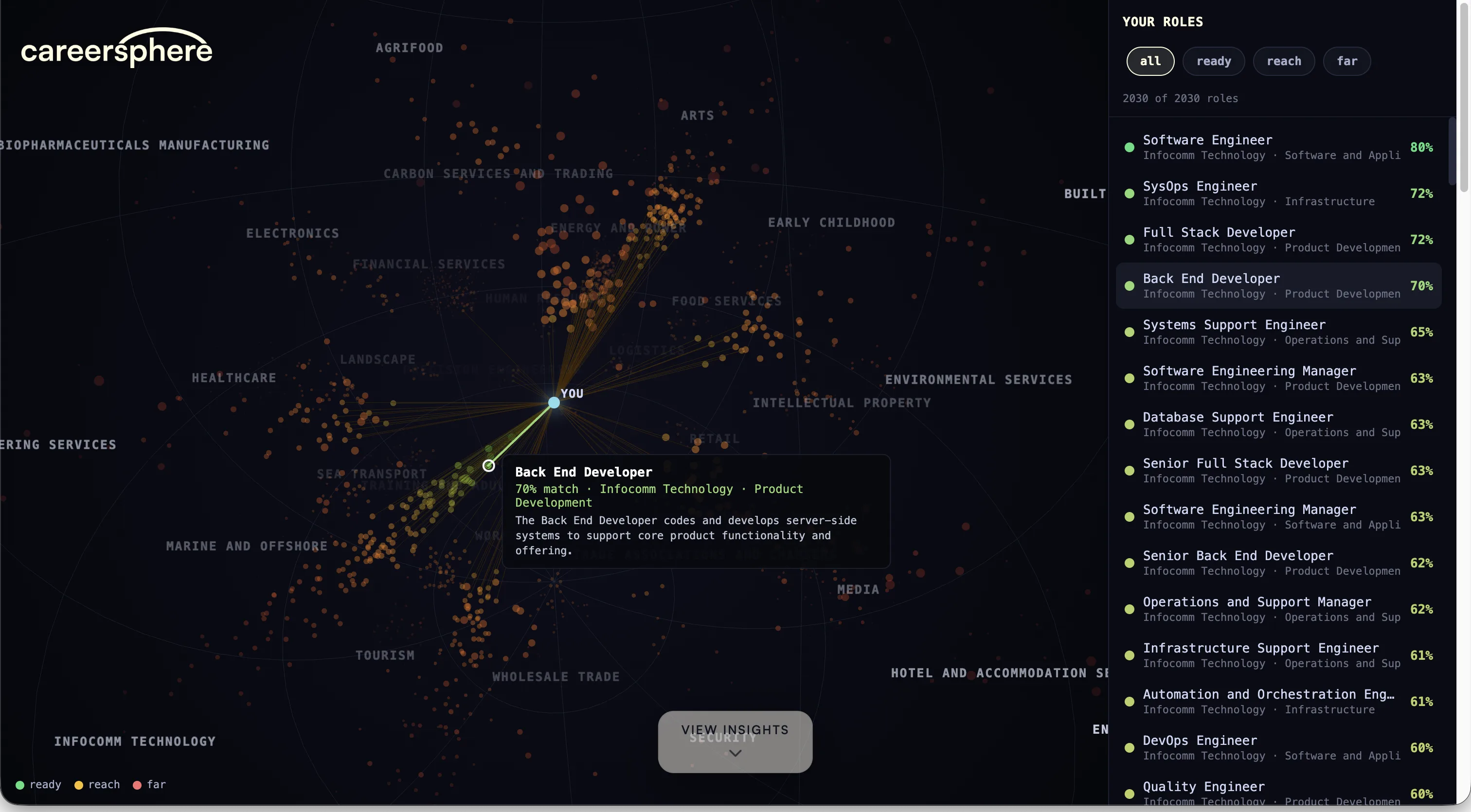
The sphere shows the whole landscape at once before the page narrows into ranked recommendations, and clusters of nearby roles make adjacent paths easy to spot.
data, agents, and live signals
The backend uses three main public data sources:
- SkillsFuture Skills Framework for official sectors, roles, role descriptions, required skills, and proficiency levels.
- MyCareersFuture job postings for what employers are hiring for right now and the skills they list.
- SkillsFuture Courses API for live course options tied to the user’s skill gaps.
The framework and job data live in DuckDB, along with embeddings for roles, skills and job titles.
Where that database lives turned out to matter a lot. Kieran’s scheduled Cloud Run job pulls new MyCareersFuture postings every day into MotherDuck, a hosted DuckDB. The first plan was for the web app to query MotherDuck directly, so I measured it: one analysis fires around 2,000 per-role lookups, each about 175 ms on a cross-region round trip, and a single analysis took over five minutes. So the deploy step bakes a DuckDB snapshot into the container image instead, where the same lookup takes about a millisecond and nothing goes over the network while someone waits on the page. A rebuild runs after each daily ingest, so the snapshot the app serves is never more than a day old. Courses stay live: once the engine knows which skills unlock a reachable role, it calls the SkillsFuture Courses API for current options.
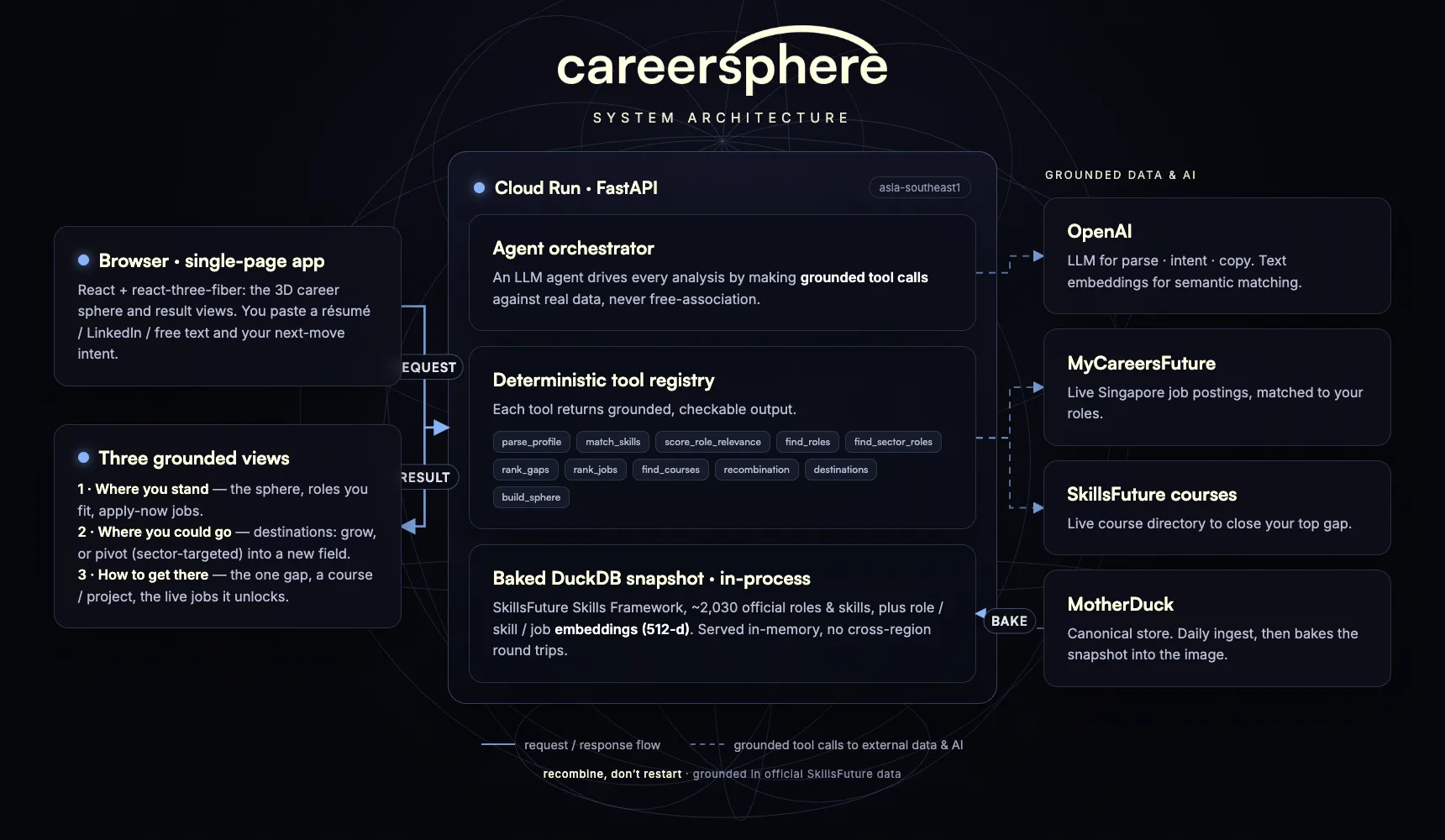
The architecture is deliberately split. OpenAI handles the language work: parsing messy profiles, working out what the user wants, embedding text for semantic matching, choosing which backend tools to call, and explaining computed results. Python handles the parts that should be auditable: role fit, gap ranking, job matching, course lookup, and the evidence shown for each result.
agent as orchestrator
The most important backend choice was letting the AI orchestrate the analysis while the data stays the source of truth. A request does not go to one giant prompt that returns career advice. Instead, the model runs inside a constrained tool loop and can call only backend tools we expose.
Those tools include:
parse_profileto turn messy resume or free-text input into structured skills and evidencematch_skillsto map user evidence to SkillsFuture skillsfind_rolesandfind_reachable_rolesto retrieve grounded role candidatesrank_gapsto choose which skill gap is most worth closing firstfind_coursesto connect gaps to SkillsFuture coursesrank_jobsto match live or cached job postings against the user’s skills
Each tool returns structured JSON from deterministic Python code. The agent can decide the sequence and explain the results, but it cannot write arbitrary SQL, invent a role, change proficiency requirements, make up salaries or courses, or override the scores. Profile parsing uses Structured Outputs, so even that step returns typed data instead of free text. If the OpenAI call fails or runs too slow, the app falls back to running the steps in a fixed order, with the same response shape.
The scoring path looks roughly like this:
profile text
  -> structured profile parse
  -> skill matching with embeddings and deterministic fallbacks
  -> official role requirement lookup
  -> role fit scoring
  -> gap ranking
  -> course lookup
  -> job ranking
  -> explanation from computed JSON
live jobs and courses
careersphere tries to connect every “you should learn X” to something the user can actually do next.
For jobs, the app ranks around 88,000 non-expired MyCareersFuture postings against the user’s current skills and the roles the engine selected. Each posting appears because its listed skills overlap with the user’s profile, and the UI keeps matched and missing skills visible so the user can tell why it is there.
For courses, the app connects the skills needed for a reachable role to live SkillsFuture course options. That matters because a gap is only useful if it becomes an action. If the system says Database Administration is one of the skills holding back a role, it should also be able to show relevant courses, providers, and registration links instead of leaving the user to search from scratch.
how fit is scored
Fit is scored against official role-skill-proficiency rows. A skill you don’t have counts as level 0, a lower level than required gets partial credit, and if the same skill maps onto a role twice, the higher required level counts.
| Signal | What it measures | Who decides |
|---|---|---|
| Role relevance | Whether the full profile is semantically close to the role | Embeddings + guardrails |
| Framework fit | How much of the official role requirement ladder the user covers | Deterministic Python |
| Gap priority | Which missing skill is close to reach, reusable across roles, asked for in job postings, and future-facing | Deterministic Python |
| Explanation | Turning the computed result into readable advice | OpenAI, from JSON |
This split mattered because official coverage on its own is useful but incomplete. Some framework rows are broad or only loosely tied to the role in practice, so the app scores semantic role relevance first and adds official coverage on top as a bonus that can lift a role but never sink it. The UI can then say “this role fits your background” while still showing which official skills are missing.
the shipped flow
The final demo flow starts with one input bar: paste text, describe your career, or attach a resume. Then the app asks where you want to go next and whether it should favor future-proof roles. A live loader runs for about 60 to 90 seconds while the backend parses the profile, matches skills, and scores all 2,030 roles.
After that, the app shows:
- the 3D sphere of official roles
- ready-now roles and aspirational next-move roles
- the skills needed to move from your current profile into a chosen role
- live SkillsFuture courses to close that gap
- matching jobs ranked by listed-skill coverage
- inline “why?” evidence and assumptions
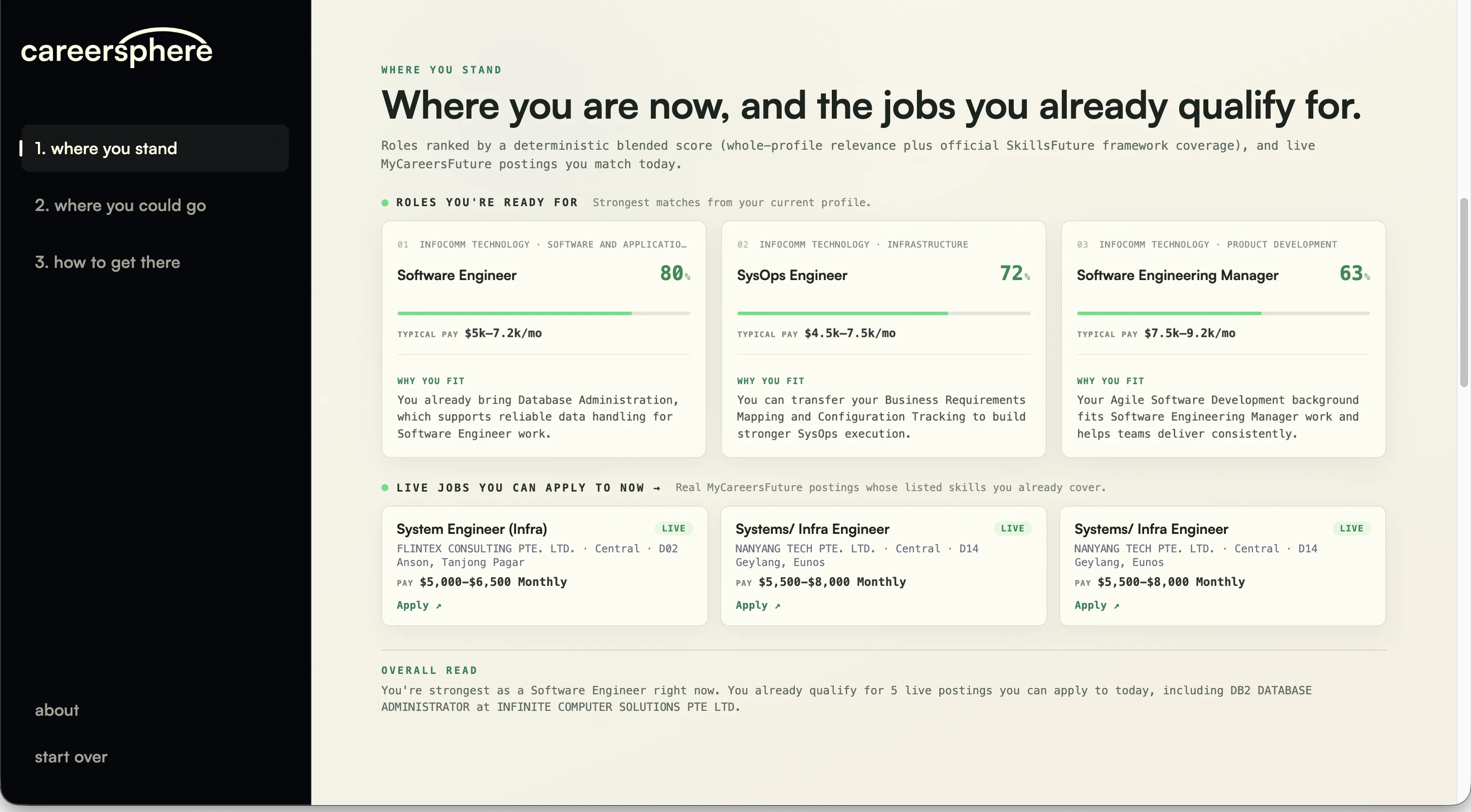
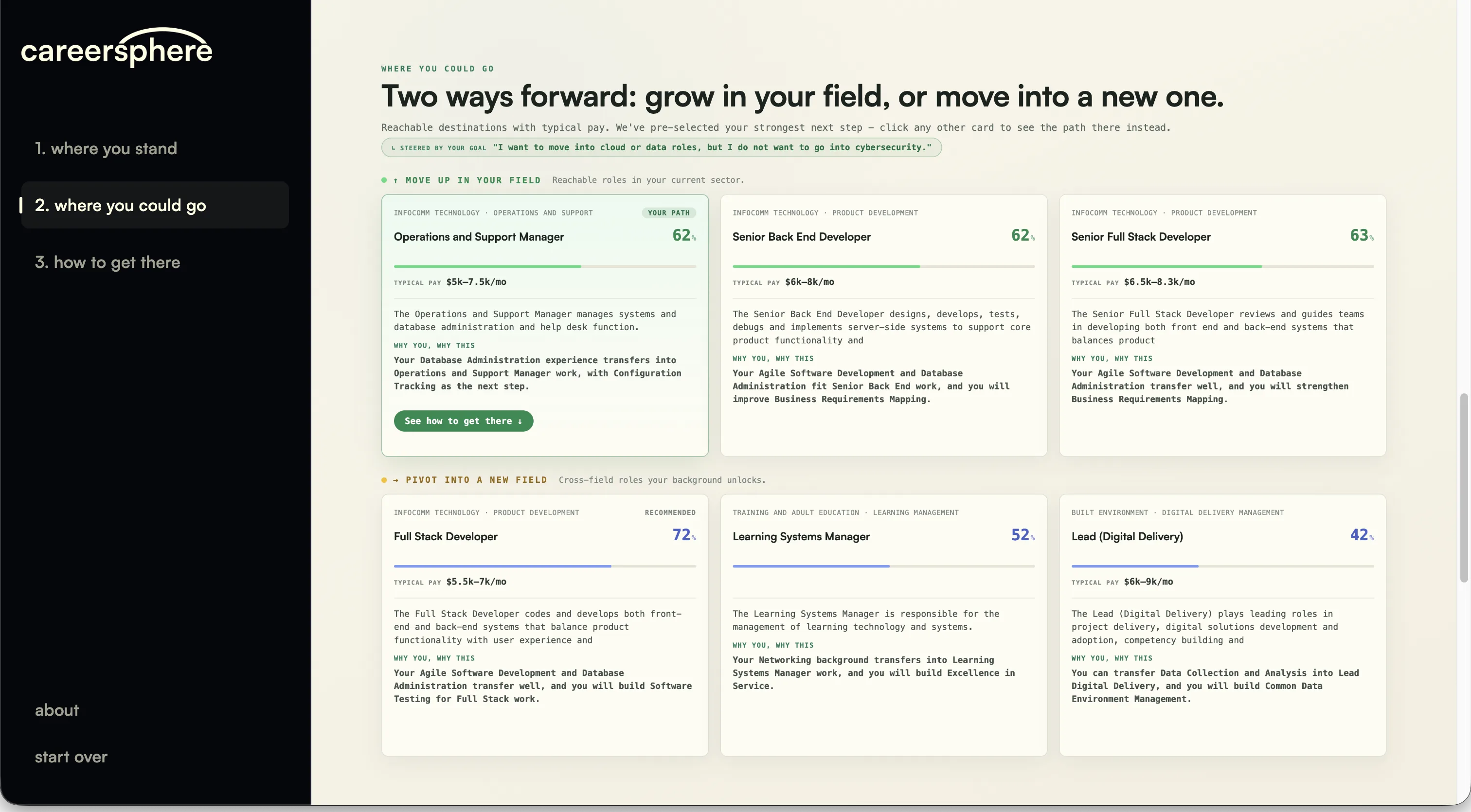
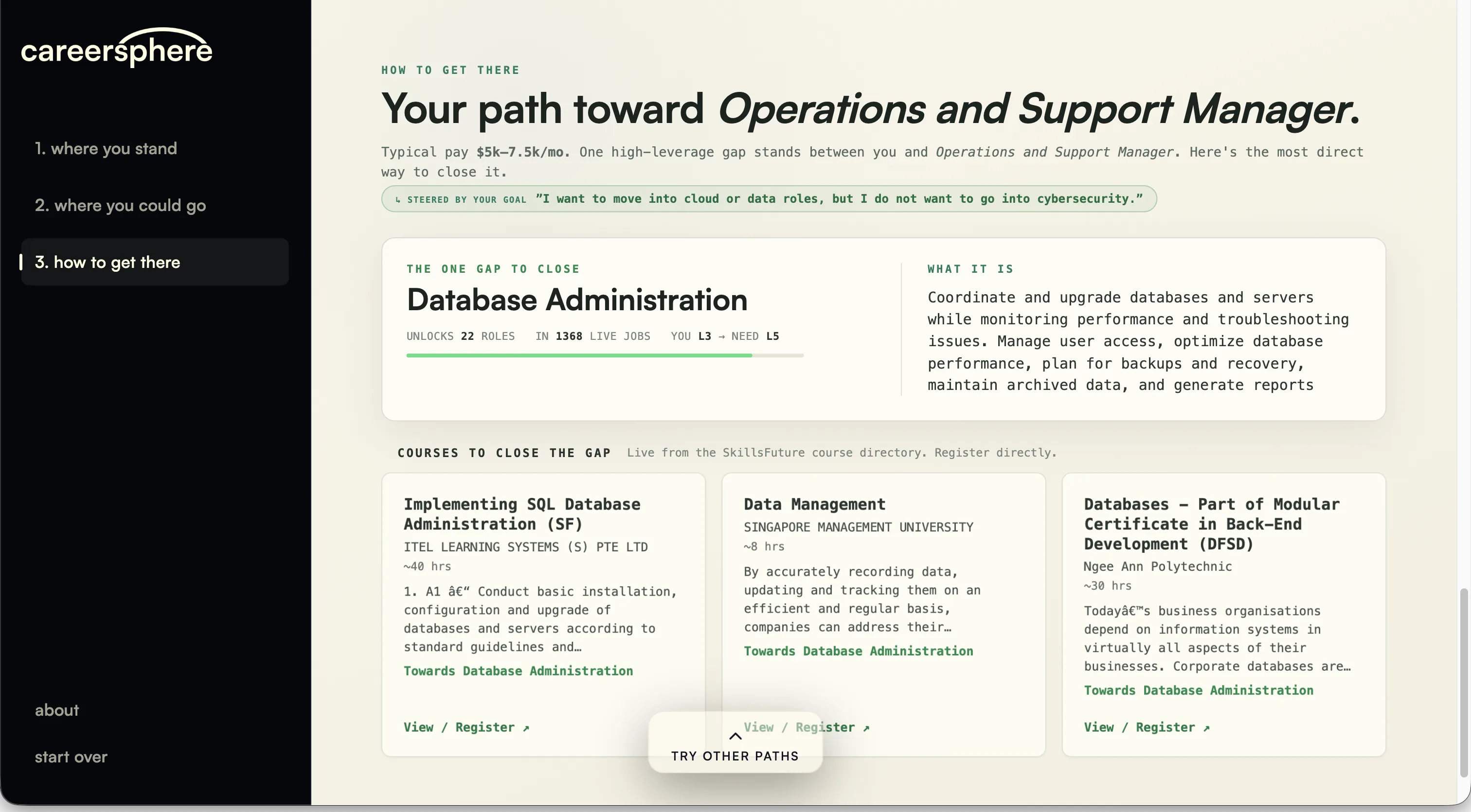
Take a non-programmer who keeps hearing “learn Python.” The app can show them that senior roles in their own field already require data analytics or automation, surface the adjacent skill that unlocks them, and point to live SkillsFuture courses to close that gap. That was the product thesis: build on what someone already has instead of telling them to restart from zero.
process as part of the build
The hackathon was judged half on product and half on process, so the repo kept a real trail: DECISIONS.md, PRD notes, data and algorithm cards, failure cases, and AI collaboration logs. The decision log helped during the build as well as for judging: each entry records what we chose, why, and what we rejected, and having that written down helped us make better tradeoffs later on.
We also kept an ai_collab_log.md, a record of each session with the AI tools: what we asked for and what we kept. Kieran and I did not split tickets and disappear into separate corners. We spent a lot of time bouncing ideas off each other, arguing through product shape, checking whether recommendations felt realistic, and deciding what to cut. Both of us had built plenty of projects alone, so the biggest shift was how much more communication the team version needed. When it worked, one person’s half-formed idea got sharper after the other pushed on it.
The most useful process rule was simple: features where the LLM decides felt like thin chatbot wrappers; features where the data decides and the LLM translates felt substantial. That rule helped us cut tempting features like a resume editor and focus on the grounded recommendation loop.
We also used AI heavily while building. Codex helped with backend loops, tests, and UI iteration, but the hard part was still judgment: checking traces, reading generated code, tuning weights, deciding which recommendations felt realistic, and making the demo robust enough to run on stage.
limitations
- The live SkillsFuture course API sometimes returns courses whose detail pages 404.
- Profile parsing is deliberately conservative and caps inferred proficiency at level 4. Senior people may get less credit than they deserve, in exchange for the model never inflating a profile.
- A full analysis takes a minute or more, which is fine for a considered career question and slow for anything interactive.
what stuck with me
Grounding is a product feature. Career recommendations need evidence because the user has to trust the advice before acting on it. Showing the source row, missing skill, and match reason belongs in the UX as much as in the backend.
A good visualization needs a job. The sphere worked because it framed the role landscape before the page narrowed into concrete actions. Without the ranked roles, gaps, jobs, and evidence around it, it would have been a cool graphic with nothing to act on.
AI agents need rails. The live OpenAI tool loop was useful because it could interpret free-form input and choose which analysis to run, but it stayed inside a small tool registry. The model did language work; the backend owned facts and scores.
Hackathon speed exposes weak architecture fast. AI assistance let us ship more than we could have by hand in the same time, but it also let technical debt pile up faster. The loop that worked was prompt, inspect, test, argue with the result, and keep the pieces that survived.